Livetrack Wand Reader Software Demo Video
From Syscan-ID RFID software video.
The video shows how to use Syscan’s Livetrack RFID software. Used for Animal Identification.
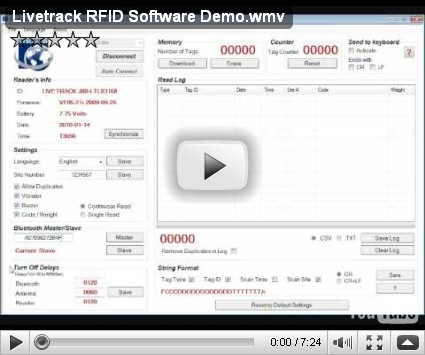
Livetrack Manager

From Syscan-ID RFID software video.
The video shows how to use Syscan’s Livetrack RFID software. Used for Animal Identification.
U.S. Ag Secretary Tom Vilsack announced a change of direction for animal disease traceability in the U.S. The new framework will apply only to animals moved in interstate commerce. States and tribal nations will administer the program to provide more flexibility. Lower-cost animal identification technology will be encouraged.

"I've decided to revise the prior policy and offer a new approach to animal disease traceability with changes that respond directly to the feedback we heard," said Vilsack.
One of USDA’s fi
USDA is moving forward.
New European Union rules for sheep farmers have come into force meaning all newborn lambs will have to be electronically tagged.
It is hoped the move will allow animals to be traced more easily.
Rural Affairs Minister Elin Jones said concessions secured from Europe should make it easier for Welsh farmers to implement the new regulations.
However, NFU Cymru said it will not necessarily mean that all newborn lambs born in 2010 will have to be tagged.
Ms Jones said: "The concessions we have secured from Europe should make it much easier for Welsh farmers to implement the EU regulations around sheep tagging.
"As of today sheep farmers will need to consider which slaughter tags they use to identify their 2010 lambs.
Nine million
"My officials will be issuing guidance and a revised flock record to all registered sheep and goat farmers in early January to help them through the new process.
"I would also urge farmers to seek advice from my officials on this issue as they will be able to provide detailed information on all aspects of the regulation."
Welsh Assembly Government officials will be advising farmers on this issue at a number of road shows across Wales during January.
There are nine million sheep in Wales and nearly half of Welsh farms keep the animals.
Read full article here. Source: BBC News
We would like to send a reminder to all our customers in Saskatchewan, the the 70% rebate program is in effect on all readers, scales, software, and accessories related to RFID Cattle traceability.
You may view our line of RFID wand readers, scales, software, and accessories at our online store. Animal ID Systems.
For further information and applications on the 70% rebate to the producer program in Saskatchewan, please contact us at animalidsystems@gmail.com


We can also create custom RFID kits, consisting of RFID wand reader, software, mobile hand held's, scale indicator, and weigh bars.
Contact us for further details on our kits.
The Canadian Cattlemen Association (CCA) has recently launched a new program called the Beef InfoXchange System or BIXS. This program is part of the Canadian Beef Advantage (CBA) program, the branding of Canadian beef for domestic and international markets, which is operated by CCA. The program has been developed because of requests from beef producers across Canada to use the unique individual animal electronic ID tags (RFID), required by all beef cattle leaving the herd of origin, to track specific individual animal data such as carcass information and pass this information up and down the chain as desired. The reports generated by the BIXS program will have the ability to highlight obvious problems or advantages. This will include analyses of the top 10 and the bottom 10 percent of your herd against the average of the general BIXS population for such variables as average daily gain in the feedlot, weaning weights, quality and yield grades.
BIXS is a national voluntary no-charge web-based database designed to capture and exchange data linked to an animals RFID tag. As BIXS develops it will turn into a valuable tool for cow-calf, feedlot and processor participants to track animal production, performance, health, genetic, economic and carcass data across the chain on an individual animal basis. The program will make it possible to communicate and build business relationships based upon accurate reliable individual animal data. Down the road the long term goal is to improve efficiencies at the ranch and feedlot level which in turn will lead to economic and overall quality benefits. Over time this will become an integral part of marketing cattle from calves to back-grounding, finishing, purebreds and on up the chain to retail, restaurants and the export market.
The BIXS program is being tested out by a group of about 100 supportive cow-calf producers and other partners across Canada. These producers are helping to test out the registration and animal data upload and transfer process to see if there are any glitches that need to be worked out before it goes to full launch to cow-calf producers and feedlots this fall. Although there is no fee for the program there is important data that needs to be entered especially at the feedlot level; information such as premise ID, date the cattle arrived, the weight of the cattle and of course the individual RFID tag number.
Read the full article here. Source: Omineca Express
Tagging is an important part of animal identification, but must be done properly. Tagging an animal is very similar to a human getting their ears’ pierced. Learn how to properly tag your animals and maintain proper care afterwards.
Figure 1. Proper tag placement location. 
Figure 2. Visual panel, or male portion of the tag.

Figure 3. EID button, or female portion of the tag.

Figure 4. Proper placement of a tag in the tag applicator.

Proper Steps to Livestock Tagging
1. Properly secure the animal to apply tag. Movement of the animal’s head could create an undesirable situation to appropriately apply the ear tag. This could cause injury to the person or livestock, or improper tagging of the animal. The following immobilization suggestions work best, depending on species:
• Cattle: Chute with a head gate, halter and/or nose lead.
• Swine: Confine in a small pen, hog boards to restrict movement, or use of a hog snare to completely secure the hog.
• Sheep & Goats: Proper hand grip of animal’s head to restrict movement.
2. Identify the tagging site on the animal’s ear.
• Tags should be applied in the middle third of the ear between the upper and lower ribs (Figure 1).
• It is important, when using electronic identification (EID) tags to apply the tag with the visual panel, male portion (Figure 2), of the tag on the outside back of the ear with the EID button, female portion (Figure 3), of the tag on the inside of the ear.
3. Proper hygiene and cleanliness during the tagging process is necessary to reduce the risk of infection. Use rubbing alcohol or a disinfectant solution to clean the jaw of the applicator. Also, clean the tagging site of the animal’s ear.
4. Place each half of the tag onto the applicator. The stud must be inserted completely onto the applicator pin and the panel/button portion placed under the opposite clip (Figure 4).
5. Before tagging the animal, check alignment of the tagger by closing the jaw of the applicator to the point where the two halves meet; the stud should be centered with the hole (Figure 5).
6. Position the applicator in the identified tagging site on the animal’s ear (Figure 6). Firmly close the applicator in a fast manner and release.
7. Examine the tag to verify it is correctly, comfortably, and securely positioned. Record necessary data on the animal.
8. Once the animal has been tagged, proper care must be taken to ensure the animal stays healthy. Daily topical application of hydrogen peroxide directly to the ear and ear tag puncture for five to seven days following the tag application will assist in preventing infection. Additional topical application of hydrogen peroxide to the ear in the following weeks is recommended until the ear is completely healed. If a serious infection occurs, consult your veterinarian for assistance and recommendations for treatment.
Figure 5. Proper tag alignment before tagging. 
Figure 6. Correct and incorrect tagging sites. 
Figure 7. Correct applicator pin. Figure 8. Bent applicator pin. 
Figure 9. Correct matching female and male portion. 
Tagging Precautions
1. Tags placed too far outside of the recommended position are prone to snagging and may be easily torn out.
2. Tags placed too far inside of the recommended position may cause pinching and/or necrosis.
3. Inspect the applicator pin to ensure the tip is in good condition (Figure 7). If the tip is bent or broken, insert replacement pin (Figure 8).
4. Check alignment by closing the jaws of the applicator
to the point where the two tag halves meet; the stud should be centered within the button hole.
5. Note that when using EID tags in Oklahoma, the number printed on the visual panel tag (male portion) should correspond and match (Figure 9) with the 15-digit number on the electronic tag button (female portion). There should be limited opportunity for error because they are nested or stored in the same package.
Source: Chris Richards and Rusty Gosz, Oklahoma State University Extension
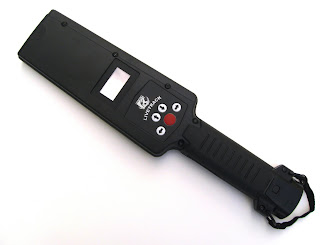
Syscan-ID Livetrack RFID Wand Reader
134.2Khz
Used by cattlemen to read RFID cattle ear tags. These tags are usually HDX or FDX-B ear tags, from Allflex, Destron, Y-Tex and so on.

The Livetrack RFID Wand reader easily interfaces with all popular cattle management software's such as Cattlemax, and Ranch Manager, just to name a few.
We also carry “RFID Wand Reader Kits”, ready to use solutions. Rugged, reliable and ready when you are.
Livetrack-Cattemax, and Livetrack-Ranch Manager.
Kits come in a hard carry case, preset to be used with the software. Cattlemax or Ranch Manager software is also included.
The reader is also compatible with most weight scale indicators, such as Reliable Scales, Tru-test, Gallagher, and many others.

One of the unique features of the Livetrack reader, is it’s firmware update software.
Very easy to use interface, to update the reader with the current firmware.
Livetrack RFID reader: “Print function” 
The Livetrack reader, has another unique feature, called the “Print Function” in the menu of the reader.
With the reader connected to the Livetrack mobile printer, it can print the template as seen on the left. The print out prints the tag EID’s along with date and time stamp, and convenient space to write additional info such as site #, and a signature as a hard copy.
We also carry this as a kit, called the Livetrack LPK, which includes, Livetrack reader (Bluetooth), rugged mobile 3” printer (Bluetooth) and hard carry case.
We can also create custom “Ready to Use” RFID kits, please contact us for more details. www.animalidsystems.com
© Copyright 2009, Animal ID Systems
© Blogger template The Business Templates by Ourblogtemplates.com 2008
Back to TOP


